
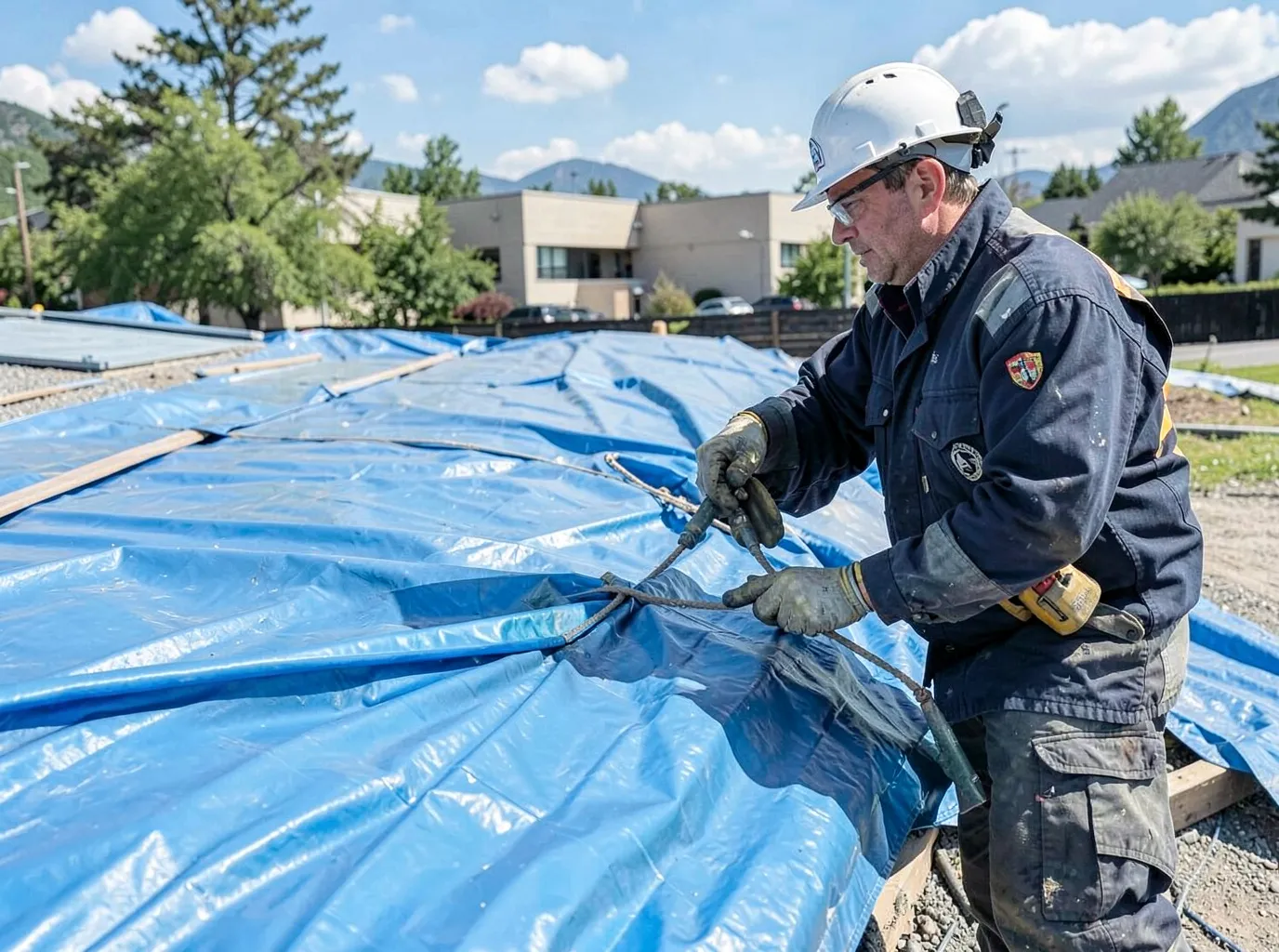
Orem sits in a semi-arid climate where hot dry summers give way to sudden intense storms that drop heavy rain on older asphalt-shingle roofs common in Sunset Heights and Geneva neighborhoods. When wind-driven rain finds a failed seam or missing shingle, water can travel under the underlayment and soak insulation within hours. Emergency tarping uses 6-mil reinforced polyethylene sheets secured with furring strips and capped nails spaced every six inches along the perimeter to create a temporary watershed that directs flow to the gutters rather than into attic spaces.
Homes near University Place and Orem City Center Park often feature steeper pitches and multiple valleys that trap debris during monsoon bursts, increasing leak risk at flashing joints. Tarping crews must first clear loose gravel and branches, then overlap sheets by at least 18 inches downhill so water cannot wick upward. In Utah County wind events, crews add extra battens across the slope and use UV-resistant tape on seams because prolonged sun exposure quickly degrades standard plastic. Homeowners in nearby Vineyard and Lindon frequently call after nighttime storms when interior ceilings begin to stain, making same-day response essential to limit drywall damage.
Local building practices in Sharon and Provo-adjacent areas include older plywood decks that can soften quickly once saturated, so tarping crews avoid walking on suspect areas and instead work from ladders or boom lifts. The goal is always to buy time for a proper roof leak repair without creating new penetrations that could void any future insurance claim. Crews document every anchor point with photos so the permanent fix crew knows exactly where to replace decking.
Technician insight
In Orem the thing that catches most people out with Emergency Roof Tarping is the older plywood decks in 1970s and 1980s homes in Sharon and Sunset Heights; once they soften from even a few hours of saturation they flex under foot traffic and tear the tarp loose during the next gust off the mountains.
Sudden Leak After Monsoon in Sunset Heights
A homeowner in Sunset Heights called after a late-evening storm when water began dripping through a bedroom ceiling. Inspection showed wind-driven rain had entered at a lifted ridge cap on the west-facing slope. Crews installed overlapping tarps secured with battens across the affected section, directing flow to the gutter and preventing further attic saturation. The tarp held through the following week until permanent shingle and underlayment replacement was completed.
Emergency Roof Tarping Services We Offer
✓Storm Damage Tarping
Rapid deployment of reinforced tarps over wind-lifted shingles in Orem Park and Geneva to prevent interior water damage until full assessment.
✓Nighttime Emergency Tarping
After-hours response for active leaks reported near Mount Timpanogos Temple or Sharon, using headlamps and battery tools to secure coverings before dawn.
✓Hail Impact Protection
Temporary covering of dented asphalt shingles common after summer hail in Sunset Heights, bridging damaged areas to stop granule loss and further cracking.
✓Valley and Flashing Tarping
Targeted tarping along complex valleys and step flashing on homes near Orem City Center Park where debris accumulates and directs water under shingles.
✓Wind-Driven Rain Tarping
Securing tarps with extra perimeter battens on exposed slopes in Lindon and Vineyard to handle gusts that push rain sideways under standard coverings.
Emergency Roof Tarping Cost in Orem, UT
| Service | Typical Range | What Affects It |
|---|---|---|
| Single Slope Tarping | $250–$450 | Typical for 200–400 sq ft sections on one-story homes in Orem Park. |
| Multi-Valley Tarping | $400–$700 | Higher when work involves complex roof planes near University Place. |
| After-Hours Response | $350–$600 | Night or weekend calls add crew availability premium. |
| Lift-Assisted Tarping | $500–$850 | Required for two-story homes in Geneva or steep terrain near Mount Timpanogos Temple. |
Ranges are typical for Orem, UT and confirmed with an exact written quote before any work starts.
How it works
- 1
Initial Assessment
Crew inspects the leak source from ladders, identifies extent of damage, and checks attic for wet insulation in neighborhoods like Sunset Heights.
- 2
Material Preparation
Select reinforced poly sheeting sized for the affected section, cut to allow proper overlap, and stage hardware for quick installation.
- 3
Secure Installation
Lay sheets with correct downhill overlap, fasten with furring strips and capped nails, then seal edges to direct water into gutters.
- 4
Documentation and Handover
Photograph all anchor points, explain temporary nature of the tarp, and schedule follow-up for permanent roof leak repair.
Pricing
Tarping is billed as a temporary measure; final cost depends on roof pitch, square footage covered, and time of day.